
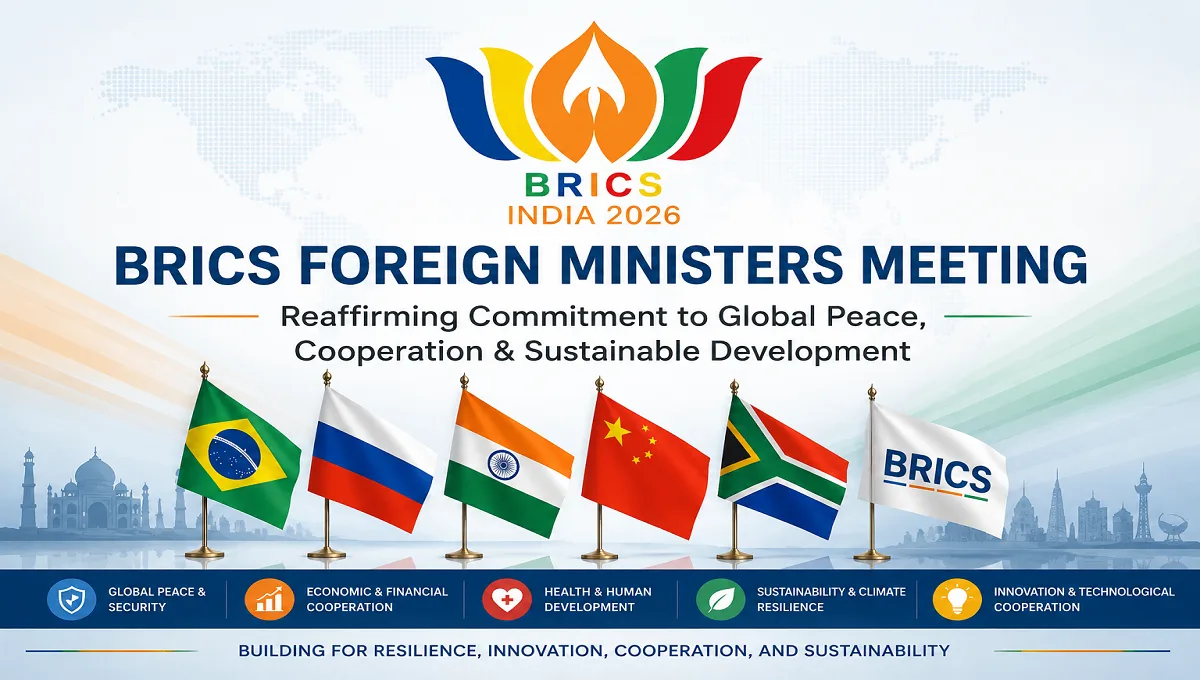
BRICS Foreign Ministers Meeting highlights multilateralism, climate cooperation, innovation, healthcare resilience, and global governance reform during talks in New Delhi.
BRICS Foreign Ministers Meeting Reaffirms Commitment to Global Governance Reform
Foreign Ministers of BRICS member countries have reiterated their collective commitment to strengthening and reforming the global multilateral system, emphasizing the need for a more equitable, democratic, and accountable international order amid rising global polarization and security challenges.
The outcome document adopted at the conclusion of the BRICS Foreign Ministers’ Meeting highlighted the member nations’ resolve to promote an international system that reflects fairness, inclusivity, and legitimacy. The Ministers observed that the current global environment marked by distrust and geopolitical tensions requires coordinated international action to preserve peace and stability.
Focus on Peace, Diplomacy and Multilateralism
Calling for greater reliance on political and diplomatic solutions to conflicts, the Ministers stressed the importance of addressing the root causes of disputes and enhancing preventive diplomacy efforts. They underlined that multilateral cooperation remains essential in tackling pressing global issues, including climate change, disaster resilience, and sustainable development.
The meeting also focused on maritime security, with the Ministers emphasizing the importance of ensuring navigational rights and freedoms for vessels of all states in the Red Sea and the Bab Al-Mandab Strait in accordance with international law.
BRICS Pushes Innovation and Economic Cooperation
On the economic front, BRICS nations underscored the growing role of their economies in promoting innovation and technological advancement. The Ministers highlighted the importance of cooperation in emerging technologies and Industry 4.0 while encouraging deeper engagement among startups and small and medium enterprises through intra-BRICS initiatives and exchanges.
Strengthening Global Health and Financial Cooperation
Global health cooperation emerged as another major area of discussion. The Ministers emphasized the need for equitable, accessible, and resilient healthcare systems and called for stronger collaboration and capacity-building initiatives among member countries.
The Ministers also advocated strengthening the BRICS Contingent Reserve Arrangement (CRA), welcoming interest from new BRICS members seeking to join the mechanism. They reaffirmed their commitment to onboarding new participants on a voluntary basis and according to country-specific circumstances.
India’s Chairship Receives Appreciation
The meeting appreciated India’s leadership under its current BRICS Chairship. Member countries and partner nations expressed strong support for India’s theme, “Building for Resilience, Innovation, Cooperation, and Sustainability,” aimed at deepening cooperation across sectors.
Briefing the media in New Delhi after the meeting, Secretary (Economic Relations) in the Ministry of External Affairs, Sudhakar Dalela, said BRICS members were able to find common ground on nearly all major issues discussed under the grouping’s three pillars — security, economic and financial cooperation, and cultural and people-to-people relations.
The meeting is seen as another step toward enhancing BRICS’ role in shaping global governance and strengthening cooperation among emerging economies in an increasingly complex international landscape.