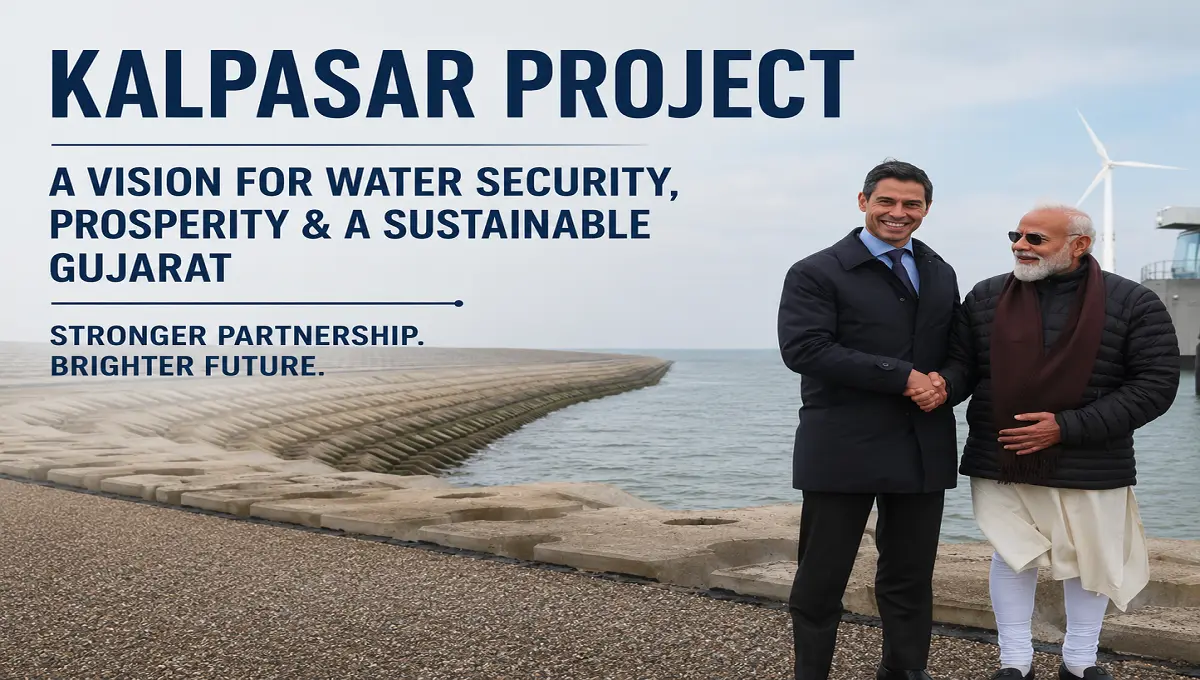
Kalpasar Project Gujarat gains fresh momentum as PM Narendra Modi strengthens technical cooperation with the Netherlands for Gujarat’s ambitious water, irrigation, renewable energy, and infrastructure project.
Kalpasar Project Gujarat
Gujarat’s ambitious and decades-old Kalpasar Project has moved a step closer toward implementation. During Prime Minister Narendra Modi’s visit to the Netherlands, India and the Netherlands signed a Letter of Intent (LoI) for technical cooperation on the Kalpasar Project, giving fresh momentum to the mega initiative.
Inspiration from the World-Famous ‘Afsluitdijk’ Dam
During the visit, Prime Minister Modi, along with the Dutch Prime Minister, visited the renowned Afsluitdijk dam. Considered one of the world’s finest examples of marine engineering and water management, the project is being viewed as a major source of inspiration for Gujarat’s Kalpasar Project. Both projects share similarities in seawater control, freshwater storage, transportation connectivity, and integrated infrastructure development.
What is the Kalpasar Project Gujarat?
The Kalpasar Project Gujarat proposes the construction of a massive dam across the Gulf of Khambhat to store freshwater from seven rivers flowing into the sea. The project aims to create a large freshwater reservoir while supporting drinking water supply, irrigation, renewable energy generation, and transportation infrastructure. The project is expected to significantly benefit water-scarce regions such as Saurashtra and Kutch.
Massive Benefits for Agriculture and Infrastructure
According to estimates, the project will provide irrigation benefits to nearly 10 lakh hectares across 42 talukas in nine districts of Saurashtra. In addition, the distance between South Gujarat and Saurashtra is expected to reduce from nearly 240 kilometers to about 60 kilometers. The project is also expected to generate around 1500 MW of wind energy and 1000 MW of solar energy, while boosting tourism and fisheries development.
A Vision Pursued for Decades
The Kalpasar Project has long been associated with Prime Minister Narendra Modi’s vision since his tenure as Gujarat’s Chief Minister. In 2004, the foundation for the project was laid through the launch of a historic marine survey in Bhavnagar. However, due to complex engineering and environmental challenges, the project faced delays over the years.
Gujarat and Netherlands Deepen Collaboration
Recently, Gujarat Chief Minister Bhupendra Patel held discussions with Dutch representatives regarding the project. Talks also included the formation of an Indo-Dutch expert group and strengthening government-to-government (G2G) cooperation for technical assistance.
Dutch Expertise to Play Crucial Role
Experts believe the Netherlands possesses world-class expertise in marine dam construction and water management, making the partnership highly significant for Gujarat. Renowned Dutch engineering firm Royal Haskoning has already contributed significantly to the Detailed Project Report (DPR), particularly in developing the critical closure methodology for the project.
New Opportunities for Gujarat’s Future
According to India’s Ministry of External Affairs, the collaboration reflects the shared commitment of India and the Netherlands toward water management, climate adaptation, and sustainable infrastructure development.
The Kalpasar Project Gujarat is being seen not merely as a water conservation initiative, but as a transformative development project capable of reshaping Gujarat’s agriculture, energy, transportation, and economic future for decades to come.