Online Gaming Rules 2026 India introduced to regulate money gaming, ensure user safety, and promote e-sports growth. Key highlights, rules, and impact explained.
Online Gaming Rules 2026 India
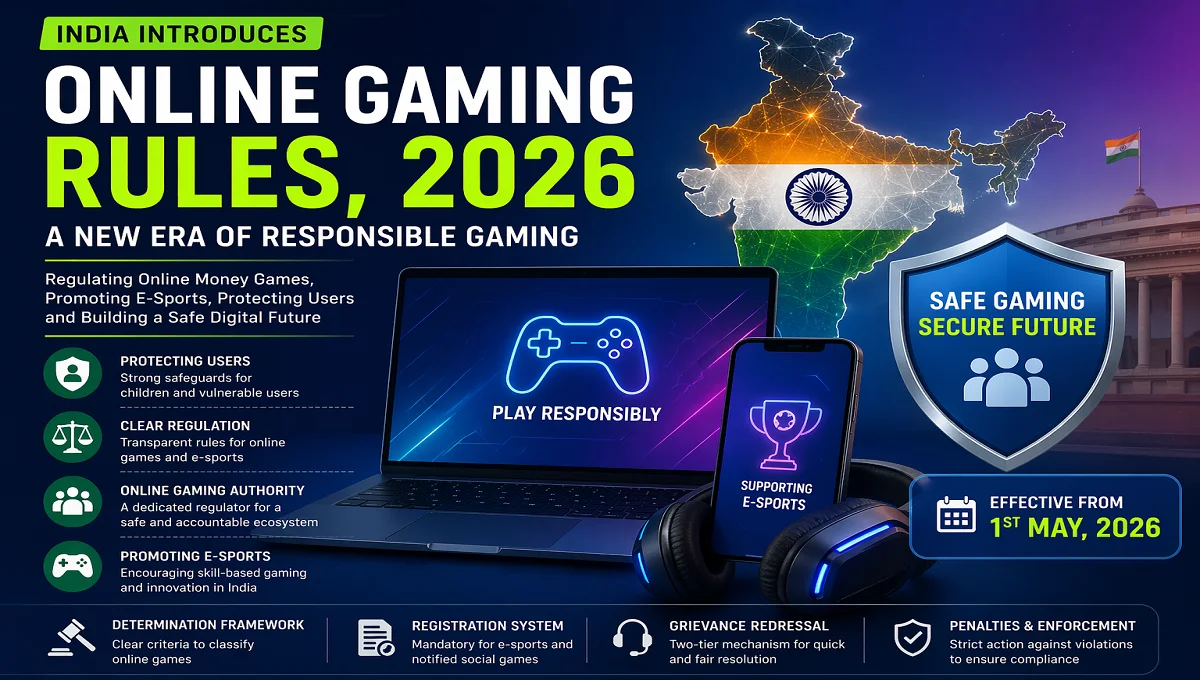
The Government of India has officially notified the Promotion and Regulation of Online Gaming Rules, 2026 India, marking a significant step toward regulating the rapidly expanding online gaming sector while safeguarding users from the risks associated with online money games.
The Rules, framed under the Promotion and Regulation of Online Gaming (PROG) Act, 2025, will come into force from May 1, 2026, and aim to create a balanced ecosystem that promotes innovation and protects citizens.
Focus on User Protection and Industry Growth
Online Gaming Rules 2026 India: The new regulatory framework seeks to address growing concerns around addictive gaming, financial losses, and misleading platforms promising quick earnings. At the same time, it aims to position India as a global hub for e-sports and digital gaming innovation.
Officials said the Rules are designed to ensure clarity, accountability, and transparency in how online games operate and are classified.
Central Regulator to Oversee Gaming Sector
A key highlight of the Rules is the establishment of the Online Gaming Authority of India, a central body under the Ministry of Electronics and Information Technology (MeitY).
The Authority will : Classify games as permissible or prohibited, Handle user complaints and appeals, Coordinate with financial institutions and law enforcement, Maintain a public list of online money games.
Clear Classification Between Games
Online Gaming Rules 2026 India: The Rules introduce a structured system to determine whether a game qualifies as an online money game or a permissible social game or e-sport. Factors such as : Entry fees or stakes, Monetary rewards, Revenue models, Redeemability of in-game assets. will be evaluated before classification decisions are made within a 90-day timeline.
Registration Mandatory for E-Sports
Online games categorized as e-sports or notified social games will require mandatory registration, valid for up to 10 years. Importantly, the government has clarified that online money games will not be eligible for recognition as e-sports, reinforcing a strict separation between skill-based gaming and gambling-like activities.
Strong User Safety Measures Introduced
To protect users, especially minors, the Rules mandate several safety features : Age verification and parental controls, Time restrictions on gameplay, User reporting systems, Access to counselling support, Fair-play monitoring mechanisms. Gaming platforms must also disclose these safeguards transparently.
Two-Tier Grievance Redressal System
The framework introduces a two-tier complaint mechanism : First level: Game service provider, Second level: Online Gaming Authority. A final appeal can be made to the Secretary, MeitY, ensuring accountability and timely resolution.
Penalties and Enforcement
Violations will attract proportionate penalties, with proceedings largely conducted digitally and concluded within 90 days. Authorities will consider : Financial gains from violations, Harm caused to users, Severity and recurrence of offenses.
A Balanced Approach
The Rules reflect the government’s dual objective : Crack down on harmful money gaming platforms, Promote a safe and thriving e-sports ecosystem. With India’s online gaming market witnessing rapid growth, the new framework is expected to bring regulatory certainty while prioritizing user welfare.
Conclusion
The Online Gaming Rules 2026 India represent a landmark regulatory intervention that could reshape India’s gaming landscape. By combining strict oversight with industry support, the government aims to foster responsible gaming while unlocking the sector’s economic and creative potential.