
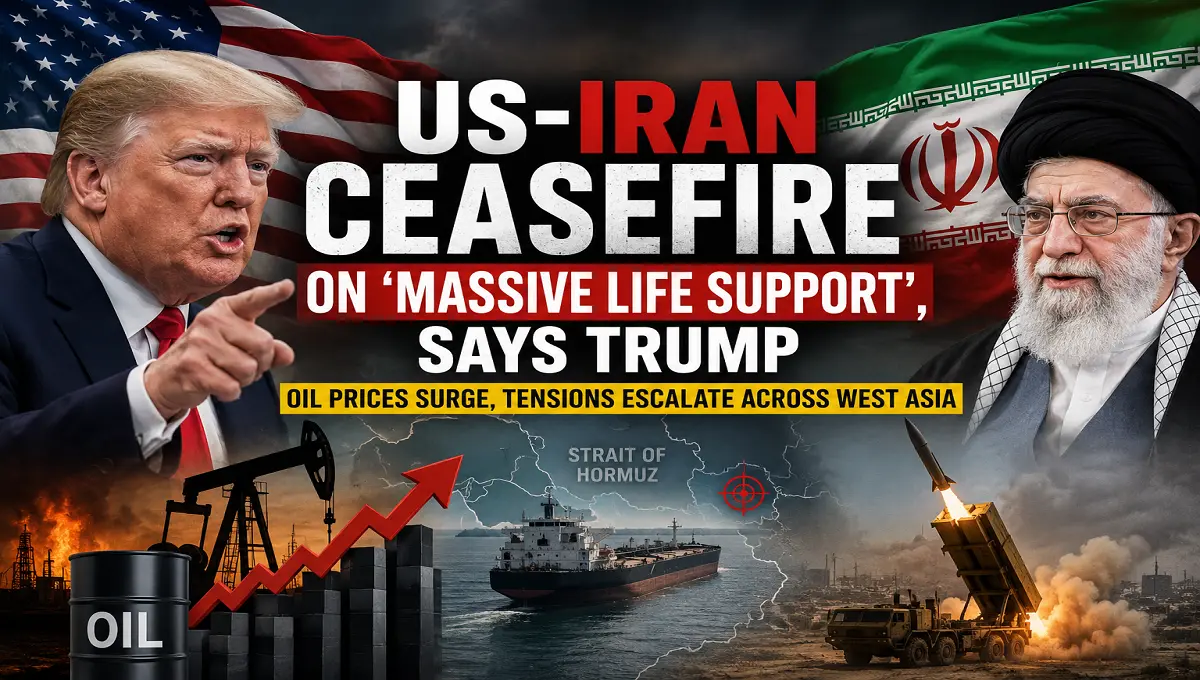
US President Donald Trump says the fragile US-Iran ceasefire is on “massive life support” after rejecting Tehran’s peace proposal, triggering sharp rises in global oil prices and renewed tensions across West Asia.
US-Iran Ceasefire on Massive Life Support, Says Trump as Oil Prices Surge
Diplomatic tensions between the United States and Iran intensified sharply after US President Donald Trump described the fragile ceasefire with Tehran as being on “massive life support”, casting serious doubt over the prospects of a lasting truce in West Asia.
The remarks came after Iran submitted its formal response to recent American peace proposals. Tehran’s proposal called for a comprehensive end to hostilities across the region, the lifting of US sanctions, the release of frozen Iranian assets, an end to the US naval blockade, and international recognition of Iran’s management role in the Strait of Hormuz.
Oil Prices Surge as Washington Rejects Tehran’s Peace Conditions
According to diplomatic sources, the Iranian proposal outlined a phased roadmap beginning with the signing of a memorandum of understanding, followed by a thirty-day negotiation process aimed at broader de-escalation.
President Trump rejected Tehran’s conditions as “totally unacceptable”, particularly objecting to the absence of immediate nuclear concessions and firm commitments on uranium enrichment restrictions.
Global Energy Markets React to Escalating Crisis
The developments sent shockwaves through global energy markets. Brent crude prices surged by more than four percent, briefly crossing 105 dollars per barrel before easing slightly later in the trading session.
Energy analysts warned that the Strait of Hormuz remains one of the world’s most strategically important oil transit routes, carrying a significant share of global crude exports. Concerns over possible disruption to maritime traffic have increased fears of prolonged volatility in international oil markets.
Officials from Saudi Aramco described the crisis as potentially the “largest energy shock in recorded history”. Company representatives warned that even if the Hormuz blockade were lifted immediately, full market stabilisation may not occur before 2027 due to ongoing supply uncertainty and elevated geopolitical risk.
Nuclear Differences Continue to Block Diplomatic Progress
Observers note that Iran’s demands focused heavily on wartime and economic conditions rather than immediate nuclear rollback measures, a framework Washington currently appears unwilling to accept.
The gap between both sides remains substantial, with international mediators struggling to establish common ground amid mounting battlefield pressure and growing economic stress across the region.
UAE Begins Legal and Infrastructure Damage Assessment
Meanwhile, the government of the United Arab Emirates has moved to formalise its response to attacks on national infrastructure linked to the wider conflict.
Authorities in the UAE have established a national committee tasked with documenting damage caused by more than 2,800 drones and missiles reportedly launched against Emirati territory. Officials say the committee will pursue international legal accountability and seek reparations for attacks targeting national landmarks and energy infrastructure.
Uncertainty Grows Across West Asia
The latest escalation has deepened uncertainty across West Asia, with global markets and diplomatic observers closely monitoring whether the ceasefire can survive mounting political and military pressures.
Conclusion – US-Iran Ceasefire
The future of the US-Iran ceasefire remains uncertain as diplomatic negotiations continue to face major obstacles. With Washington rejecting Tehran’s latest conditions and tensions rising across West Asia, fears of renewed military escalation and prolonged economic disruption are growing worldwide.